
Implantate, Chirurgie & Zahnersatz

Dental implants in Geroldswil: fixed teeth, planned on the computer

A dental implant is an artificial tooth root that heals into the jawbone and gives crowns, bridges or dentures a firm hold. We plan implants on the computer with the NobelGuide® method – for precise positioning and the gentlest possible procedure.

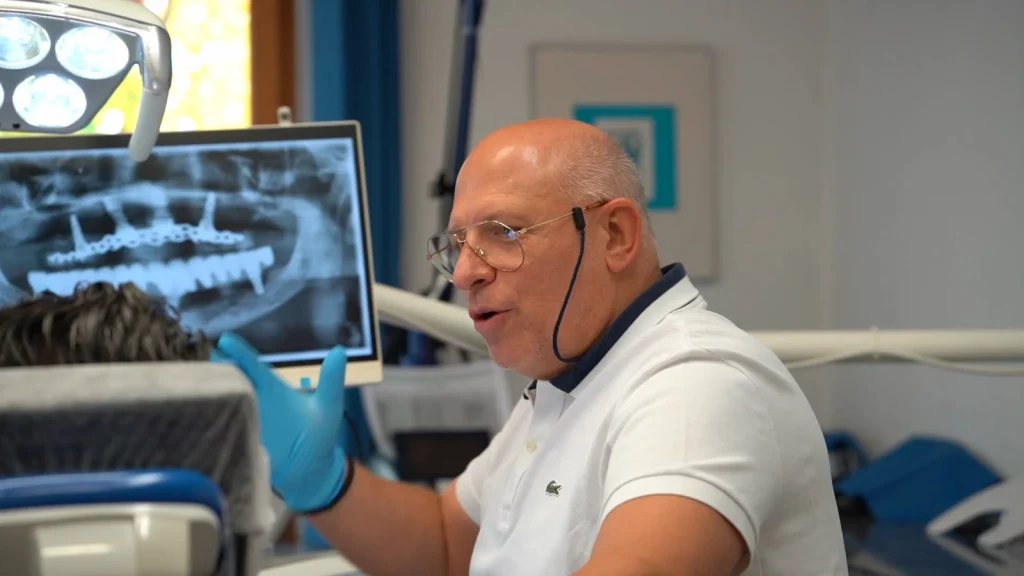
Dr. Mihail erklärt ein Panorama-Röntgenbild mit implantatgetragenem Zahnersatz

Auf einen Blick

Healing time
Usually three to six months
Anaesthesia
Local, general anaesthesia if indicated
Planning
Computer-guided with NobelGuide®
Health insurance
Basic insurance only in exceptional cases

Dental implants: kurz erklärt

An implant consists of three parts: the implant body, anchored in the jawbone as an artificial root, the connecting piece (abutment) and the visible crown. Implants are usually made of titanium; there are also metal-free implants made of zirconia ceramic.

After placement the implant fuses with the bone (osseointegration). Single crowns, bridges or removable dentures can be attached securely to one or more implants.

We work with the computer-guided NobelGuide® method: the position of the implants is planned on the computer from a three-dimensional X-ray and transferred precisely with a surgical guide. This makes the best use of the available bone; for many patients an extensive bone graft can be avoided. The necessary 3D scan is taken by a specialised radiologist.
Wann ist die Behandlung sinnvoll?

  • A single missing tooth, without grinding down the neighbouring teeth
  • Several missing teeth as the basis for a fixed bridge
  • A toothless jaw: a firm hold for a denture
  • A loose denture that should hold better

So läuft die Behandlung ab

  1. Diagnosis and planning

    We examine the jawbone and your oral health. For the NobelGuide® method we refer you to a specialised radiologist for a 3D scan; we then plan the implant position on the computer.

  2. Procedure

    The implant is placed under local anaesthesia, with the guided method often without opening the gums extensively. If there is not enough bone, a bone graft may be necessary.

  3. Healing phase

    The implant usually fuses with the bone within three to six months. During this time you wear a temporary restoration if needed.

  4. Final restoration

    After healing, the abutment is attached and the custom-made crown, bridge or denture is fitted.

Vorteile

  • A firm fit and a secure bite
  • The neighbouring teeth do not have to be ground down
  • No bothersome clasps
  • Implants counteract bone loss
  • Guided, minimally invasive procedure: often less swelling

Risiken und Grenzen

Like any surgical procedure, implant placement can involve swelling, bruising and temporary pain. Less often, wound-healing problems, infections or – in the lower jaw – irritation of nerves with altered sensation can occur. In individual cases an implant may not heal in or may be lost later.

Uncontrolled diabetes, heavy smoking, certain medicines and conditions such as osteoporosis can impair healing. In the long term, peri-implantitis – inflammation around the implant – is the most important risk; good care and regular check-ups reduce it considerably.

Nachsorge

Cool the area from the outside in the first hours after the procedure, do not smoke and be gentle with the area. Implants themselves do not decay, but they need careful care: brushing twice a day with a soft brush, cleaning between the teeth with floss or interdental brushes, and regular professional cleaning and check-ups.

Häufige Fragen

How long does implant treatment take?

The whole treatment takes several months: after the procedure there is a healing phase of usually three to six months, then the definitive crown is fitted. If a bone graft is needed, treatment can take longer.

Does having an implant placed hurt?

The procedure is carried out under local anaesthesia. In the days afterwards swelling and discomfort can occur, which can usually be treated well with painkillers. If medically indicated, treatment under general anaesthesia is also possible.

Does health insurance cover the costs?

In Switzerland, basic compulsory health insurance covers dental implants only in exceptional cases. Supplementary insurance reimburses part of the cost depending on the policy. It is best to clarify coverage with your insurer in advance.

How much does an implant cost?

The costs depend on the scope of treatment, the materials and any additional measures such as a bone graft. In the consultation you find out what costs to expect. Payment in instalments is possible.

I have a quote from abroad. Can you compare?

Yes. For treatments planned and quoted abroad, we prepare a counter-offer for you free of charge.

Ihre Ansprechpartner

Zuletzt aktualisiert: 22. Oktober 2026

Diese Informationen ersetzen keine persönliche Untersuchung und Beratung. Ob und wie eine Behandlung für Sie sinnvoll ist, besprechen wir mit Ihnen in der Praxis.

Weiterlesen

  • Oral surgery

    Tooth extraction, wisdom teeth, bone grafts and sinus lifts – gently with ultrasonic surgery.

  • Crowns, bridges & dentures

    Crowns, bridges and dentures – on your own teeth or on implants, functional and aesthetic.

  • Treatment under general anaesthesia

    When medically indicated, we treat under general anaesthesia – administered by a specialist anaesthesiologist in our practice.

Wir nehmen uns Zeit für Sie.

Rufen Sie uns an oder vereinbaren Sie Ihren Termin. Bei akuten Beschwerden finden wir rasch eine Lösung – auch kurzfristig.

Öffnungszeiten

Jetzt geöffnet · bis 20:00 Uhr

Montag – Samstag
08:00 – 20:00
Sonntag
Telefonisch erreichbar, 24 Stunden

Termine nach Vereinbarung. Akute Beschwerden auch ohne Termin.