
Special care

Children's dentistry: relaxed first steps towards healthy teeth

We take plenty of time for our young patients. Through play, children learn to get used to visiting the dentist – and discover early how important it is to look after their teeth.

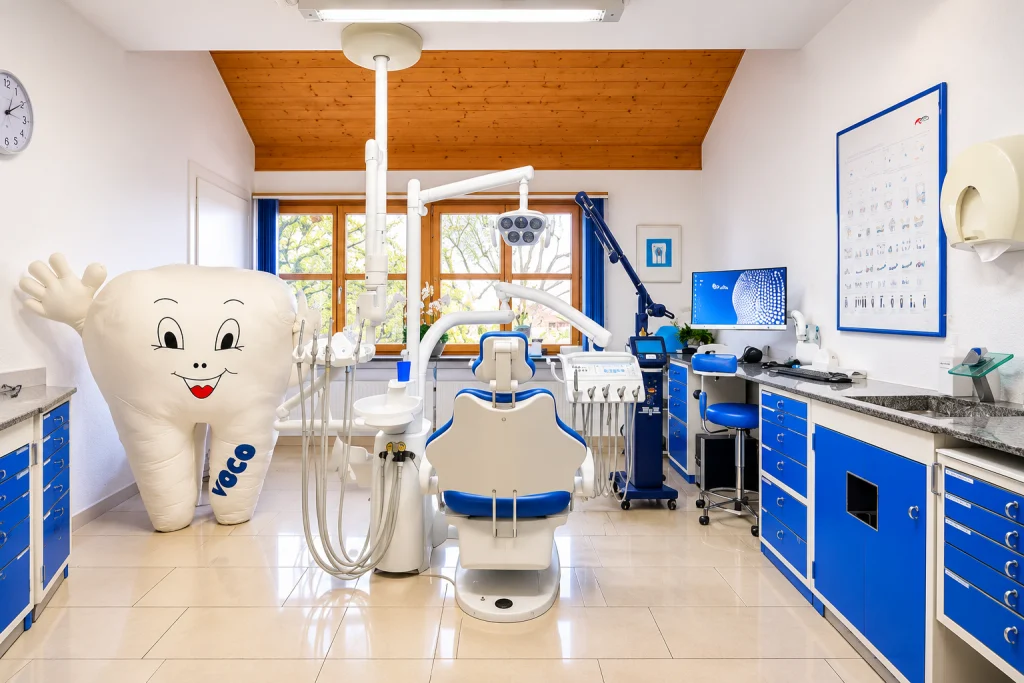
Behandlungszimmer mit blauen Schränken, Holzdecke und einem grossen Plüschzahn als Maskottchen

At a glance

Anaesthesia
Computer-controlled, with a very fine needle
Advice
For parents from pregnancy onwards

Children’s dentistry explained

Healthy teeth are the result of the right care and regular check-ups from the very beginning. As soon as the first baby teeth come through, bacteria settle on their surfaces; with insufficient care and a sugary diet, the risk of decay rises with every year of life.

Our advice ranges from the right behaviour during pregnancy and measures in infancy to tooth-friendly nutrition and oral hygiene. If treatment is needed, we use the computer-controlled STA anaesthesia system (The Wand) with a very fine needle for children, so that the anaesthesia is as comfortable as possible.

When is the treatment appropriate?

  • Regular check-ups from the baby teeth onwards
  • Advice for parents on dental care and nutrition
  • Treatment of decay in baby and permanent teeth
  • Dental accidents in children

How the treatment works

  1. Getting to know us

    At the first visit your child gets to know the practice calmly. We look at the teeth without pushing.

  2. Check-up and advice

    We check teeth and gums and show child and parents how to care for the teeth properly.

  3. Prevention

    With nutrition tips and preventive measures we help avoid decay.

  4. Treatment, if needed

    If treatment is needed, we explain each step in a child-friendly way and numb as gently as possible.

Benefits

  • Plenty of time and empathy
  • Gentle, computer-controlled anaesthesia
  • Playful familiarisation with the dentist
  • Advice for parents from the start

Risks and limitations

Treatment can sometimes be unpleasant for children too, and not every child can be treated in the same way. We proceed carefully and discuss with you if another approach is better. While the area is still numb after anaesthesia, your child should not eat, so as not to bite the lip or cheek.

Aftercare

Brush your child's teeth twice a day with an age-appropriate children's toothpaste and help until your child can brush thoroughly alone. Sugary drinks and frequent snacks increase the risk of decay. Regular check-ups help detect problems early.

Frequently asked questions

When should my child first see the dentist?

Parents can do a lot for their child's dental health in the first months. We are happy to advise you on when a first visit makes sense and take plenty of time for the first contact.

Will my child feel the injection?

For children we use a computer-controlled system with a very fine needle and a small, evenly delivered amount of anaesthetic. Many children find this much more comfortable than a conventional injection.

Your contacts

  • Dr. medic. stom. (Ro) D. C. Catalin Mihail Dentist
  • Dr. stomat. (Universität Prishtina) Gazmend Spahiu Assistant dentist

Last updated: 22. October 2026

This information does not replace a personal examination and consultation. Whether and how a treatment is right for you is something we discuss with you at the practice.

Read on

  • Dental hygiene & prevention

    Professional cleaning, check-ups and advice so that decay and gum disease do not develop in the first place.

  • Dental emergency

    Severe toothache, swelling or a broken tooth: our practice phone is answered around the clock.

  • Treatment under general anaesthesia

    When medically indicated, we treat under general anaesthesia – administered by a specialist anaesthesiologist in our practice.

We take time for you.

Give us a call or book your appointment. For acute problems we find a solution quickly – even at short notice.

Opening hours

Currently closed

Monday – Saturday
08:00 – 20:00
Sunday
Reachable by phone, 24 hours

Appointments by arrangement. Acute problems also without an appointment.